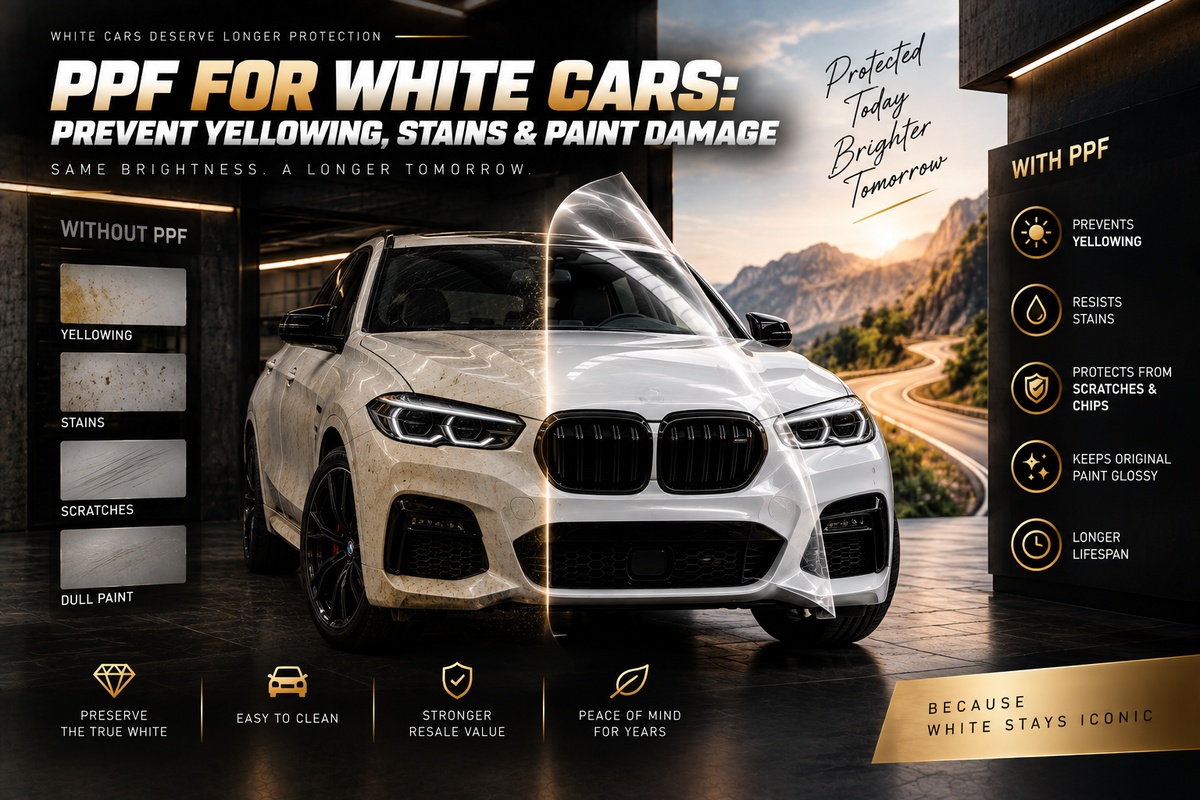
PPF for White Cars: Prevent Yellowing, Stains & Paint Damage
A white car looks clean, elegant and premium when the paint is fresh. That fresh look is also what makes white one of the toughest colours to maintain over the years. Keeping that bright finish looking new on Indian roads can be challenging.
Dust, road grime, bird droppings, tree sap, hard water marks, UV exposure and stone chips can gradually take their toll on white paint. Even small stains and scratches can become highly visible against a light coloured surface. A single tar spot that would barely register on a black car can look like a permanent mark on white.
This is where PPF for white cars can make a real difference. A quality Paint Protection Film creates a transparent protective layer over the original paint, helping protect it from everyday damage while preserving the car’s factory appearance. Think of it as a sacrificial skin that takes the hit so your paint doesn’t have to.
Why Does White Car Paint Need Extra Protection?
White paint does not necessarily damage faster than darker colours, but imperfections can be easier to notice. Colour uniformity is the real challenge any discolouration breaks the illusion of a flawless white finish far quicker than it would on a darker shade.
For example, a small bird dropping stain, yellowish residue or road tar spot can stand out strongly on a white bonnet. Over time repeated exposure to sunlight and contaminants can also affect the paint’s appearance. Owners who skip protection often notice the bonnet and roof ageing faster than the rest of the car simply because they take the most direct sun.
Common threats to white car paint include:
- Bird droppings and acidic contaminants
- Tree sap and insect residue
- Road tar and grime
- UV exposure
- Stone chips and road debris
- Fine scratches and swirl marks
- Hard-water spots
- Chemical stains
- Frequent washing and polishing
A properly selected white car PPF acts as a sacrificial layer between these contaminants and the original paint. In practice this means the film takes on the wear and can be replaced while the factory paint underneath stays untouched.
How Does PPF for White Cars Help Prevent Yellowing?
One of the biggest concerns among white car owners is whether PPF itself will turn yellow. This fear isn’t unfounded early generation films were notorious for developing a faint amber tint within a couple of years, especially in highUV climates like India.
This is why the film’s anti yellowing performance matters more than almost any other spec on a white car.
A low quality or ageing film can potentially become visibly discoloured, which is especially noticeable on white paint. A quality film should therefore have strong resistance to yellowing and environmental ageing. A film that yellows defeats its own purpose you end up protecting the paint while making the car look older than it is.
UCPPF’s transparent PPF is designed to stay clear and resist yellowing over time. With a ΔE ≤ 3 yellowing rating and ageing resistance testing, the film helps protect the vehicle’s original colour while maintaining a clean, transparent finish.
For anyone specifically searching for an anti yellow PPF for white car, this is an important specification to check rather than choosing a film based only on thickness or price. Ask the installer for the ΔE rating in writing a genuine spec sheet is a good filter against films sold purely on marketing claims.
Can PPF Prevent Stains on White Paint?
PPF cannot make a car completely stain proof, but it can provide an additional protective barrier against many everyday contaminants. It shifts the odds in your favour rather than guaranteeing a stain free life.
The hydrophobic surface of a quality film helps water dirt and contaminants resist sticking to the surface. This can make routine washing easier and reduce the chances of contaminants remaining on the surface for extended periods. A well maintained hydrophobic coat also means fewer swirl marks from wiping down dust, since less grime clings to the surface in the first place.
This is particularly useful in Indian driving conditions, where a car can encounter dust, pollution, rainwater, mud and bird droppings regularly. Monsoon months and tree lined parking spots tend to be where this protection earns its keep the most.
However, contaminants should still be removed promptly. PPF is protection not an excuse to leave bird droppings or chemicals sitting on the car for days. Acidic residue left too long can still etch even a protected surface over time.
PPF for White Paint: Protection Beyond Stains
Staining isn’t the only concern. Impact and abrasion damage tend to worry owners just as much once they’ve had the car a while.
A white car driven regularly on highways can encounter small stones gravel and road debris. These impacts can chip the paint, particularly around the bonnet bumper mirrors and other exposed areas. On white cars a stone chip often exposes a darker primer layer underneath, making it far more visible than the same chip would be on a similarly coloured car.
PPF provides a tough TPU based protective layer that helps absorb and resist everyday surface damage. The film flexes on impact rather than cracking, which is what allows it to shrug off gravel strikes that would otherwise chip factory paint.
UCPPF’s transparent PPF products are tested for gravel impact resistance and are specified to pass the SAE J400 Gravel Strike and Crack Experiment. That’s an industry recognised benchmark, not just an in house claim, which gives buyers a more objective way to compare films.
What About Scratches?
Modern PPF can also help with minor surface scratches. This is one of the more underrated benefits since daily wear like car wash brush marks tends to add up quietly over time.
Several UCPPF films use self repair or heat-repair coating technology. Minor surface marks can recover when exposed to suitable heat, depending on the specific product. On a hot day, simply parking the car in direct sun can be enough to smooth out light swirl marks on some self healing films.
This doesn’t mean PPF is immune to every scratch or impact. Deep cuts can still damage the film. The advantage is that many everyday fine marks can be reduced or repaired without affecting the original paint underneath, which is exactly the kind of low-level wear that shows up fastest on white.
Does Clear PPF Change the Look of a White Car?
This is one of the biggest advantages of clear PPF for white car owners. Unlike ceramic coatings or wraps it isn’t meant to be noticed at all.
Transparent PPF is designed to preserve the vehicle’s original colour and appearance rather than changing it. A good installation should be virtually invisible in normal light with only close inspection under certain angles revealing the film’s edge.
A properly installed clear film can provide a glossy protected finish while keeping the white paint looking like white paint. The goal is protection you can’t see if the film is noticeable that’s usually a sign of a lower-grade product or a rushed installation.
For owners who love the factory colour and don’t want to change the appearance of their vehicle transparent PPF is generally the natural choice.
Best PPF for White Car: What Should You Look For?
Don’t choose a PPF simply because it is advertised as premium. That word gets used loosely across the industry and rarely tells you anything about the actual film specs.
When comparing the best PPF for white car look at specifications such as:
- Anti yellowing performance
- Film thickness
- Self healing or heat-repair technology
- UV and ageing resistance
- Hydrophobic properties
- Stone chip resistance
- Elongation
- Warranty
- Installation quality
Elongation deserves more attention than it usually gets a higher elongation percentage means the film stretches around curves and edges without stress whitening, which matters a lot on bumpers and mirror caps.
The installer also matters Even a high quality film can look poor if it is incorrectly fitted contaminated during installation or badly maintained. Ask to see examples of the installer’s past work on white or light coloured cars specifically since edge lifting and dust particles show up far more obviously on white.
UCPPF PPF Options for White Cars
UCPPF offers several transparent PPF options that can suit white cars depending on the owner’s priorities, budget and desired warranty period. The lineup is built around a clear tradeoff longer warranty and thicker film generally mean a higher price point.
1. UC Premium +240 For Maximum Long Term Protection
If long-term protection is your priority, UC Premium +240 is one of the strongest options in the UCPPF transparent range.
It features a room temperature repair coating, 240% substrate elongation, ΔE ≤ 3 yellowing level and a lifetime warranty. Room temperature repair means minor marks can smooth out without needing a heat gun or direct sun.
The film is specified at 9.5 mil ±3% on UCPPF’s portfolio page and is tested for gravel impact ageing and humidity resistance.
Best suited for White car owners looking for premium protection and long term ownership.
2. UC Premium 210 Premium Clear Protection
UC Premium 210 offers instant self repair coating technology with 8.5 mil ±3% thickness 260% substrate elongation and a ΔE ≤ 3 yellowing level.
It comes with a lifetime warranty according to UCPPF’s current product specifications. Instant self repair is a genuine convenience upgrade for owners who don’t want to wait around for marks to heal.
Best suited for Owners who want a premium clear PPF with strong self repair characteristics and long term warranty coverage.
3. UC Max+190 Strong Balance of Performance & Warranty
UC Max+190 uses an instant self repair coating and has a 7.5 mil ±3% thickness. It offers 280% substrate elongation, a ΔE ≤ 3 yellowing level and a 10-year warranty. Its high flexibility makes it a strong choice for vehicles with sharp curves and body creases.
Best suited for Daily driven white cars where durability, flexibility and long-term protection are important.
4. UC Insta 190 Instant Self Repair Technology
UC Insta 190 is another transparent option with instant self repair coating.
It has 7.5 mil ±3% thickness, 260% substrate elongation, ΔE ≤ 3 yellowing level and an 8 year warranty. This sits in a practical middle ground for owners who want self healing performance without paying for the top tier warranty.
Best suited for Car owners looking for self repairing clear PPF with a strong balance between protection and warranty period.
5. UC Pro+ 190 Heat Self Repair Protection
UC Pro+ 190 uses heat self repair coating technology and offers 7.5 mil ±3% thickness, 260% substrate elongation and ΔE ≤ 3 yellowing level.
Its current listed warranty is 7 years. It’s a solid entry point into the range for owners who want proven self-repair performance without committing to the longest warranty tiers.
Best suited for Owners looking for reliable clear PPF with heat-activated self repair technology.
Which UCPPF PPF Is Best for a White Car?
When choosing PPF for white cars, the priority should be more than just thickness. Yellowing resistance, clarity, self-repair technology, UV protection and long-term durability are particularly important because any change in film clarity can be noticeable on white paint. A film that scores well on thickness alone can still let you down on colour stability the two specs don’t always move together.
For white car owners three UCPPF transparent PPF options stand out and Each one targets a slightly different priority so the right pick usually comes down to how long you plan to keep the car.
UC Premium +240 Best for Long Term White Paint Protection
If your priority is long-term protection UC Premium +240 is a strong choice. It sits at the top of UCPPF’s transparent lineup for owners who don’t want to think about refilming the car for years.
It features a room temperature repair coating, 240% substrate elongation and a listed yellowing level of ΔE ≤ 3. It also offers ageing and humidity resistance and comes with a lifetime warranty. Room temperature self repair is a genuine convenience light swirl marks can smooth out on their own without needing a heat gun or a hot afternoon sun.
For owners specifically concerned about keeping white paint looking clean and clear for years, this makes it one of the most relevant UCPPF options to consider.
UC Premium 210 Premium Clear PPF with Self Repair
UC Premium 210 is another excellent option for owners looking for premium clear PPF for white car protection. It’s built for owners who want top-tier clarity without necessarily needing the thickest film available.
It uses an instant self repair coating and has an 8.5 mil ±3% thickness, 260% substrate elongation and a listed yellowing level of ΔE ≤ 3. It also carries a lifetime warranty. Instant self repair means marks smooth out almost immediately rather than waiting for the right temperature conditions, which matters if the car is parked indoors or in shade most of the time.
Its combination of clarity self-repair technology and yellowing resistance makes it particularly suitable when maintaining the original white finish is the priority.
UC Max+ 190 Long-Term Protection with Instant Self Repair
For owners looking for a balance between advanced protection and long term warranty coverage, UC Max+ 190 is worth considering. It is positioned as the practical middle ground in the range rather than the outright premium option.
It features instant self-repair coating, 280% substrate elongation and a ΔE ≤ 3 yellowing level. It comes with a 10-year warranty. The higher elongation figure stands out here it gives the film more stretch around curves and body creases without stress marks showing through.
This makes it a practical choice for a daily-driven white car where protection from minor scratches, stains, road contamination and environmental exposure is important.
Which One Should You Choose?
There is no single best PPF for white car for every owner. The right choice really depends on how long you plan to own the car and how much you’re willing to spend upfront versus over time.
- Maximum long-term protection: UC Premium +240
- Premium clear finish + instant self-repair: UC Premium 210
- Strong protection + 10-year warranty: UC Max+ 190
All three are part of UCPPF’s transparent PPF range and have a listed ΔE ≤ 3 yellowing level, making them especially relevant for owners who want to preserve the clean appearance of white paint. A ΔE ≤ 3 rating across the board means the choice between these three comes down to warranty length and repair technology, not colour stability.
The final choice should also consider the car’s usage, ownership period, budget and importantly the quality of installation. Even the best film on this list can underperform if it’s fitted by an inexperienced installer, so it’s worth weighing the applicator’s track record as heavily as the spec sheet itself.
Frequently Asked Questions
PPF for White Cars: Prevent Yellowing, Stains & Paint Damage
A white car looks clean, elegant and premium when the [...]
The Ultimate Guide to Washing and Maintaining a Car with PPF
If you’ve spent good money on PPF you already know [...]
Car PPF Cost in India 2026: Complete Price Guide by Car Type
If you are planning to protect your car's original paint [...]
Colour PPF: The Smartest Way to Change Your Car Look without Repainting
Car customization in India has changed a lot. A years [...]
Frontend PPF vs Full Body PPF : Which Is Better for Your Car?
Buying a new car is exciting, but keeping the paintwork [...]
PPF for Black Cars: Complete Guide to Protecting Black Car Paint
A black car looks stylish when it is clean and [...]
Want to grow your car detailing business? Join UC PPF as a franchise partner and become a part of the fast-growing car care industry. We are offering Paint Protection Film Franchise opportunities to detailing studios and entrepreneurs. Get premium products, training, branding support & a lifetime warranty system. Connect with us today and explore why detailers across India trust UC PPF for #paintprotectionfilm and #carppf solutions.